

Trout Season Begins
by Capt. Steven Holmes
Contributing Editor at Large
 As
I am sure many of you have been painfully aware, Speckled Trout season has been
closed for the last three months. While I too have missed the opportunity to catch
Speckled Trout, I must say that I agree with the Marine Fisheries Commission decision
on closing trout season during their predominate schooling period. I think of
it this way, deer hunters – myself included – would like to have a year round
season. Nevertheless, if our government officials hadn’t the wisdom to implemented
a deer season instead of allowing hunting year round the last deer would have
gone the way of the Buffalo along time ago.
As
I am sure many of you have been painfully aware, Speckled Trout season has been
closed for the last three months. While I too have missed the opportunity to catch
Speckled Trout, I must say that I agree with the Marine Fisheries Commission decision
on closing trout season during their predominate schooling period. I think of
it this way, deer hunters – myself included – would like to have a year round
season. Nevertheless, if our government officials hadn’t the wisdom to implemented
a deer season instead of allowing hunting year round the last deer would have
gone the way of the Buffalo along time ago. The good news has been that here in North East Florida Yellow-mouth Trout, Sheepshead, Whiting, and Reds have been in abundance and local fisherman have had great success with these species. On March 1st, when the season re-opens, you will find me on the water with one of my charters catching some fresh Speckled Trout for the dinner table. In the winter months, Speckled Trout move into deeper waters to avoid the temperature fluctuations but in March most of the cold fronts have stopped coming through Florida’s first coast. So, if you happen to be fishing just after old man winter’s last squall, look for Trout as well as other species in deeper water. For natural holes look around creek bends, creeks and river inlets, man-made canals and channels as well as the Intercoastal Waterway (ICW) drop offs. As the sun heats up the shallow waters, you will find Trout chasing shrimp in to the grass flats, and shallow creeks.
In other articles, I have stated to match your bait to what your quarry is feeding on – ”Match the Hatch.” Since I know that Trout are looking for a nice Shrimp dinner, my predominate bait will be live Shrimp as big as I can find them or soft plastic that resembles a Shrimp (DOA Shrimp).
When the water is still cold use a light jig head. Here in North East Florida, I am talking about 60-degree water as being cold. For some reason this is the magical temperature when almost everything slows way down. For this reason alone make sure your boat has a temperature gauge and use it. On the first spring days use your temperature gauge and find the warmest water. That’s where you will find fish holding up. Power plants and other industrial plains are well known for holding fish in their unpolluted discharge waters.
When I am fishing an artificial grub in shallow water, I use something in the area of 1/16 to 1/4-oz Jaw Jacker jig head. This makes your grub descend slowly. Work your grubs by lifting your rod tip 4-6 inches and then letting it down. Then reel in your slack and start all over again. Your strikes will usually happen on your grub’s descent.
On warmer days I will first work the grass flats adjacent to deeper water, the entrances of creeks, (both tidal and flowing) next to drop-offs, etc. Then I will work my way back into the creeks with a cast and retrieve method using a trolling motor. Use grubs, or a live Shrimp hooked through the tail, and weighted with only split shot or a very light 1/8 –1/4oz jig head.
 While
I love the action of top-water lures, this normally would not be the right time
of year to use them. But due to our unusually warm temperatures this winter, I
have not had to put them up all through out the season. In the early spring, I
prefer grubs like DOA’s
assortment including the light 1/8-oz and ¼ Shrimp and Mr. Wiffle, and
Kelly Wiggler’s 3.5-inch soft plastics. Make sure you work your grubs slow, I
mean really S L O W. When you get a bite make sure you give old Mr. Trout enough
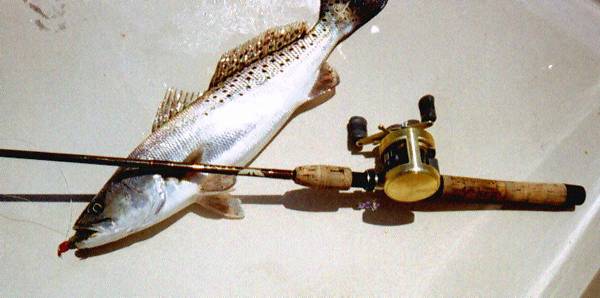
time to take the bait. I like using a bait casting reel for artificial lures because
I feel that bait casters give me the control that is needed in the narrow creeks
of North East Florida. They work equally as well in the Mangrove waters of the
Everglades and other areas where control is of the utmost importance. I use a
medium light action-spinning reel for live bait. Spinning reels are easier to
cast with less force on the live bait, therefore putting less strain on live bait
when casting.
While
I love the action of top-water lures, this normally would not be the right time
of year to use them. But due to our unusually warm temperatures this winter, I
have not had to put them up all through out the season. In the early spring, I
prefer grubs like DOA’s
assortment including the light 1/8-oz and ¼ Shrimp and Mr. Wiffle, and
Kelly Wiggler’s 3.5-inch soft plastics. Make sure you work your grubs slow, I
mean really S L O W. When you get a bite make sure you give old Mr. Trout enough
time to take the bait. I like using a bait casting reel for artificial lures because
I feel that bait casters give me the control that is needed in the narrow creeks
of North East Florida. They work equally as well in the Mangrove waters of the
Everglades and other areas where control is of the utmost importance. I use a
medium light action-spinning reel for live bait. Spinning reels are easier to
cast with less force on the live bait, therefore putting less strain on live bait
when casting.
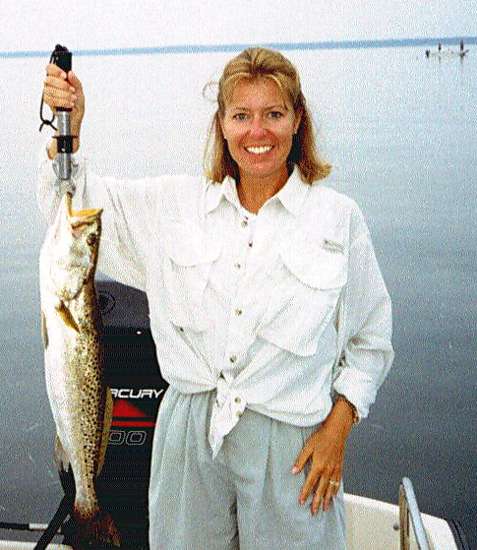
My Wife Karen (pictured above) has for years been using a 21st century float rig called Cajun Thunder. (A new product from the people who manufacture The Equalizer) Utilizing this Cajun Thunder with a live shrimp her results have been deadly on Trout, Snook, Reds and a whole list of other species to long to list. Instead of making a popping sound it makes a clicking sound similar to that made by Crabs or Shrimp trying to leave the areas in a hasty retreat. The best way I can explain it is, picture this, a fish hearing this sound swims over to find his dinner trying to flea the area. Then as he is looking up at this surface rig and trying to figure it out a nice live shrimp floats down on top of him. It’s almost immediate, and for this reason artificial soft plastics work just as well.
 When
the tide is all the way out work the shelf of the ICW and along the grass flats
that are still accessible. For working the ledge of the ICW or other deep waters,
I prefer two different methods. A medium diving lure like MirrOlure 38MR, MirrOlure
TT and the old model 52M as well as Rapala’s shallow Shad Rap, and Bomber Long
A 2.5 and 4 inch shallow water diver are excellent. You can always use one of
the soft plastics mentioned earlier with a ¼ oz or 3/8 oz Jaw Jacker jig
head. Again, in the cooler waters of spring make sure you slow down your presentation.
When
the tide is all the way out work the shelf of the ICW and along the grass flats
that are still accessible. For working the ledge of the ICW or other deep waters,
I prefer two different methods. A medium diving lure like MirrOlure 38MR, MirrOlure
TT and the old model 52M as well as Rapala’s shallow Shad Rap, and Bomber Long
A 2.5 and 4 inch shallow water diver are excellent. You can always use one of
the soft plastics mentioned earlier with a ¼ oz or 3/8 oz Jaw Jacker jig
head. Again, in the cooler waters of spring make sure you slow down your presentation.
This article was reprinted from Jacksonville Fisherman.
Click on above photo for larger version,
remember to use your browser's back button
to return.
 You can contact
Capt. Steve at:
You can contact
Capt. Steve at:
904-825-1784
E-mail: [email protected]
Web Site: http://southwindcharters.com/
 Back
to Fishing Articles
Back
to Fishing Articles
| Travel | Marketplace | Weather | Jump Aboard | Feedback |
| Fishing Links | Forum | Search | Home |
Questions and comments: Please use our Contact Form.